Fire Evacuation Procedure
Stillwater Community Hall, 1A Stillwater Hall, Hibiscus Coast Local Board, Auckland Council
1. Purpose
This procedure explains what hall users, hirers, volunteers, staff, contractors, and visitors must do if there is a fire or fire alarm at the community hall. It is intended to help occupants evacuate safely, promptly, and efficiently to a place of safety.
2. Emergency Contacts
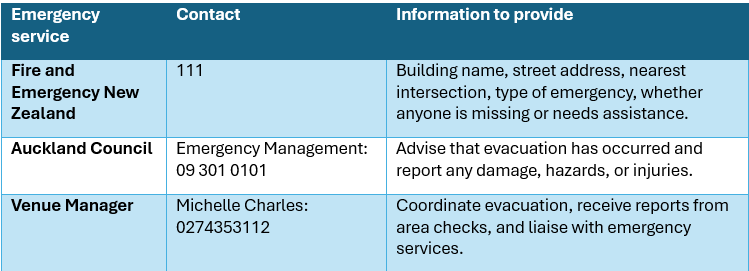
3. If You Discover a Fire
1. Raise the alarm immediately by shouting “Fire, fire, fire”.
2. Activate the nearest manual call point or alarm if safe to do so.
3. Call 111 and ask for Fire. Use a mobile phone from outside the building if possible.
4. Evacuate by the nearest safe exit. Do not stop to collect belongings.
5. Close doors behind you if it is safe to do so, to help limit the spread of smoke and fire.
6. Follow illuminated exit signs and the directions of fire wardens.
7. Go directly to the designated assembly point in park by drinking fountain and report to the Building Warden or person in charge.
8. Do not re-enter the building until Fire and Emergency New Zealand or the Building Warden confirms it is safe.
4. If You Hear the Fire Alarm or Are Warned of Fire
1. Stop activities immediately and stay calm.
2. Follow the instructions of the Building Warden, event organiser, or person in charge.
3. Assist children, older people, disabled people, and anyone who needs help, only where it is safe to do so.
4. Leave by the nearest safe exit and proceed to the assembly point.
5. Remain at the assembly point until everyone has been accounted for and the all-clear is given.
5. Assembly Point
The designated assembly point is: corner grass area of park near road and drinking fountain. The assembly point must be away from the building, vehicle access routes, smoke, overhead hazards, and emergency service access areas.
6. Responsibilities
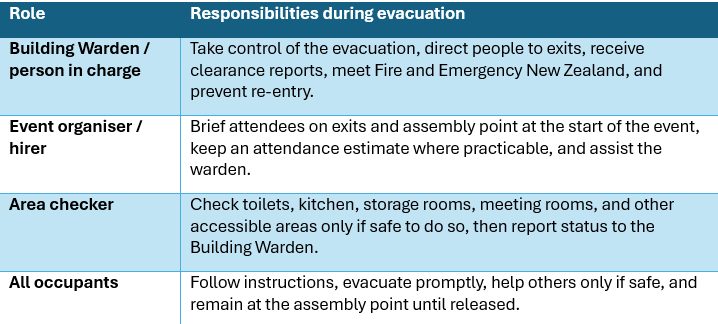
7. Assistance for People Who May Need Help
The event organiser or person in charge should identify, before or at the beginning of the event, whether anyone may need assistance to evacuate. Assistance must be provided only where it is safe and must not delay the evacuation of others. If someone cannot be moved safely, notify Fire and Emergency New Zealand immediately and provide their location.
8. Firefighting Equipment
Fire extinguishers or hose reels may be used only by trained people, only for small fires, and only if there is a clear escape route. Do not use water on electrical or flammable-liquid fires. Personal safety takes priority over property protection.
9. Occupant Briefing for Hirers and Event Organisers
At the start of each booking or event, the hirer or organiser should briefly advise attendees of the nearest exits, the assembly point, the need to evacuate immediately if the alarm sounds, and the requirement not to re-enter the building until authorised.
10. Training, Trial Evacuations, and Review
Wardens and regular hall users should be familiar with this procedure, exit routes, alarm points, firefighting equipment locations, and the assembly point. Trial evacuations should be practised at least every six months where required or appropriate, and this procedure should be reviewed after any evacuation, building layout change, change in occupancy, or at least annually.